MSc thesis project proposal
[2026] Ultrasound-Enhanced Smart Tactile "E-Skin" for Humanoid Robotics
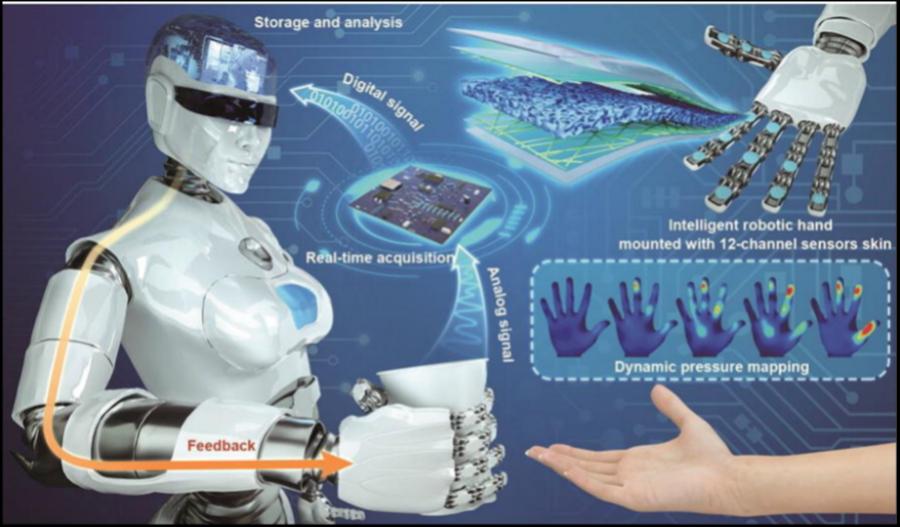
Background and Motivation: The sense of touch is a critical faculty enabling humanoid robots to interact safely and reliably with delicate objects. To achieve human-like dexterity, a smart tactile "e-skin" is required to help robots perceive their environment and modulate their grip force dynamically. Existing tactile solutions—primarily based on capacitive, resistive, or optical sensors—face significant limitations: they are typically reactive (only activating upon physical contact) or susceptible to ambient light interference. These drawbacks often result in suboptimal precision and increased system latency, hindering real-time interaction
Project Goal: This project aims to bridge the gap between proximity sensing and tactile feedback by exploring novel "e-skin" architectures utilizing ultrasound technology. Unlike traditional methods, ultrasound can detect objects before physical contact occurs and predict material characteristics based on acoustic impedance. This "pre-touch" capability allows the robotic system to proactively determine the appropriate force profile, ensuring seamless and gentle handling of diverse objects.
Scope of Work: The project offers a multi-disciplinary research scope covering:
- Fabrication: Design and manufacturing of ultrasound transducers and flexible e-skin substrates.
- Electronics: Development of high-performance readout circuits and real-time signal processing units.
- Adaptability: The project focus can be customized (e.g., emphasizing hardware fabrication vs. circuit design) based on the student's background and research interests.
This project is a collaborative initiative between Dr. Q. Fan and Dr. T. Costa.
Assignment
Student Responsibilities:
- Literature Review: Conduct a comprehensive study on the current state-of-the-art in smart tactile "e-skins" and ultrasonic sensing.
- Architecture Exploration: Propose and simulate an innovative ultrasonic e-skin system design.
- System Implementation: Develop a proof-of-concept prototype integrating transducers and readout electronics.
- Verification & Analysis: Perform rigorous measurements to validate detection accuracy, latency, and material prediction capabilities.
Requirements
MSc students from Microelectronics or Biomedical Engineering. Interested students should include their CV, the list of courses attended, and a motivation letter.
Contact
dr. Tiago Costa
Bioelectronics Group
Department of Microelectronics
Last modified: 2026-02-12